Who would think that amid the remnants of the Wild West there would be a dedicated group of children and adults dancing and singing the beloved songs of the Rusyn people? Here in Arizona, where “ethnic” usually means the lively culture of the Mexicans and the story songs of the range cowboys, there also is the charming entertainment of Rusyny.
Begun two years ago with inspiring motivation from Leslie Kurtak of Tucson, the group has grown to 22 members who spend countless hours learning new songs and dances, researching and sewing costumes and introducing a whole new heritage to this part of the country. Ms. Kurtak is a member of St. Melany’s Byzantine Catholic Church in Tucson, and the group has been fortunate to have found a home practicing in the church’s social hall and storing their growing costume wardrobe there as well.
In Tucson there was no one available to teach these dances. So through research on the internet Ms. Kurtak discovered Jack and Dean Poloka, founder, co-directors and choreographers of Slavjane from Pittsburgh, PA. They were kind enough to travel across country to nurture the budding Rusyn heritage in Arizona. Under their tutelage, Rusyny strives to authenticate the songs and dances of the people of the Carpathian Mountains. Couples spin to the lively Czardas, the women and girls swing with the Karicky, and the boys use their ball-park athleticism in the Male Kozačko and axe dances!.png) The group performs 10-12 times each year at such events as the Tucson Meet Yourself heritage festival and the biannual European Fairs sponsored by the European Multi-ethnic Alliance of Tucson. The group has also entertained such organizations as the Czechoslovak Genealogical Society International, the Knights of Columbus, the Greek Catholic Union, and the Order of Foresters. The group was also privileged to perform at the Installation of His Grace William Skurla as Bishop of the Van Nuys Diocese of the Byzantine Catholic Church.
The group performs 10-12 times each year at such events as the Tucson Meet Yourself heritage festival and the biannual European Fairs sponsored by the European Multi-ethnic Alliance of Tucson. The group has also entertained such organizations as the Czechoslovak Genealogical Society International, the Knights of Columbus, the Greek Catholic Union, and the Order of Foresters. The group was also privileged to perform at the Installation of His Grace William Skurla as Bishop of the Van Nuys Diocese of the Byzantine Catholic Church.
Rusyns in the Southwestern Desert
People in the rest of America might be surprised to learn there are people of Slavic heritage living in the Southwest. Of the 5 million people who call Arizona home, over 22,000 are foreign born from Eastern European countries! Like many others, they moved west, particularly to the drier climates of Arizona, Nevada and New Mexico, for health or retirement reasons. And then there are thousands more descended from foreign-born Americans, who retain and cherish their heritage. They are represented in the Byzantine Catholic, Russian Orthodox, Roman Catholic and Ukrainian Catholic Churches. The Van Nuys Diocese of the Ruthenian Byzantine Catholic Church alone numbers 1,500 families in 19 parishes. However, today this diocese is not made up exclusively of those of Slavic heritage. The eparchy embraces parish communities made up of Slavs, Anglos, Hispanics, Jamaicans, Australians, Eskimos, Native Americans, African-Americans and Asians. We are certainly a melting pot. And Rusyny is also a fine example that you don’t have to be of Slavic heritage to enjoy performing and sharing the rich heritage of the Slavic people. Only half of the members can claim at least a portion of Eastern European roots. But that only underscores all of the group’s members’ love and commitment to Rusyn culture!.png) Discovering Hidden Talents
Discovering Hidden Talents
Rusyny Music Director Liz Haight is actually “mostly Irish!” As a teenager, she fell in love with the heritage of the Slavic countries. She once found a “Teach Yourself Russian” book in the library for her sister who was working on a school paper about Russia. “But her interest had petered out by then, so I started looking through it, and I guess it just really caught my interest,” Ms. Haight said. “To give my Celtic heritage its due, I did once get a book on learning Gaelic, but it was so incomprehensible that I gave up. Russian was a piece of cake, comparatively!” Both Slavic languages, Rusyn and Russian of course have much in common.
Most of Rusyny’s members find it’s the children and teenagers who keep this group going strong and staying young. The littlest Junior member, Dominic Vallone, is a whiz with “Coffee Grinders” (squatting on one leg while spinning the other around). And Patti Hill, mother of 15-year old Gretchen, commented during rehearsal about six months after the group started, “one day Gretchen woke up Rusyn – singing and dancing like she was born in the Carpathian Mountains!” Gretchen, who performs with the Dancing for the Lord Ballet Company (sponsored by A Time to Dance Studio in Tucson), possibly hopes to audition for the world-renowned Tamburitzans of Duquesne University one day.
Many of the members have had to share special talents to bring the fledgling group to reality. And some had to dig deep within to discover before-unknown gifts. Ms. Kurtak creates the patterns from which the women and girls sew the costumes, Eddie is currently painting a Carpathian Mountain scene on the new stage backdrop, John Hvasta cuts out axes, and Nicole Kojanova keeps the group attuned to the Czech and Slovak communities in Tucson.
Rusyny has been blessed to discover many inspirational and financial supporters during the last two years. The Greek Catholic Union, Tucson Chapter, presented the group with a grant which was appropriated for new costumes. Also, St. Melany’s former pastor, now-Bishop William Skurla, and its present pastor Rev. Robert Rankin, have been gracious to allow the group to use the church hall for practices and meeting places before and after performances.
Challenges Conquered
The group brings choreographers Dean and Jack Poloka to Tucson at least once yearly for an intensive three-day workshop that is videotaped. After consultation with Rusyny members to decide what they would like to learn, Dean and Jack provide the choreography (written out step-by-step), sheet music and cassette tapes. And although the group’s “tutors” are 2100 miles away, they are always eager to answer their many questions by phone and email.
Although none of the members have any professional dancing or musical background, they spend hours reviewing the tapes, marking out steps, and encouraging each other to perfect the steps and pronounce the words of the songs correctly. And one of their greatest trials has been to rid their American accents – the New Jersey nasals and the Texas twangs – from the newly-learned Rusyn and Slovak!
Performing under the strong Arizona sun in 100+ degree temperatures has definitely been a challenge for the members. They’ve all come to appreciate the endurance of some of their female ancestors in Europe who wore many layers of petticoats and skirts! The group has opted to sew blouses, skirts and petticoats out of modern lightweight polyester-cotton fabric which hasn’t detracted from the authenticity they strive for. The vests, however, are velvet and brocade. And with the hundreds of studs on the men’s vests, the weight alone provides a good workout during the 30-45 minute performances!
“Senior” member John Hvasta when asked his age, responded with “I’m 20 years too late and 20 pounds too heavy for the group! But this is something I dreamed of doing since I was a teenager. My father was born in Slovakia, and my mother’s parents were from Slovakia and Hungary, so my brothers and sister and I grew up very ‘ethnic.’ But there never was a dance group in our area of Virginia. My wife and daughters and I are very proud to be members of Rusyny.”
Most importantly, the members always share a lot of fun sprinkled throughout their hard work. When the men practice the axe dance, you can sometimes find a “baba” shadowing their moves with a rolling pin! And sometimes when the women practice, you can find a “dzedo” in babushka and apron trying to blend into the group!
The group always welcomes new members – of any age or gender! Look for the group at the next inter-national festival in the Tucson and Phoenix areas. To join the group or to attend a workshop, contact Director Leslie Kurtak at deserttea@yahoo.com. To have Rusyny perform for your next event call the Booking Coordinator Diane Hvasta at (480) 325-0602 or at deehvasta@yahoo.com.
(Photos courtesy of Diane Hvasta and Rusyny)
Showing posts with label united states. Show all posts
Showing posts with label united states. Show all posts
11.7.07
A Bit of the Carpathians amid the Cowboys and Indians
Diane Hvasta, Tucson Outpost Dispatch #2, November 2003


17.1.07
The (Rusyn) Russian Orthodox Church in Jersey City
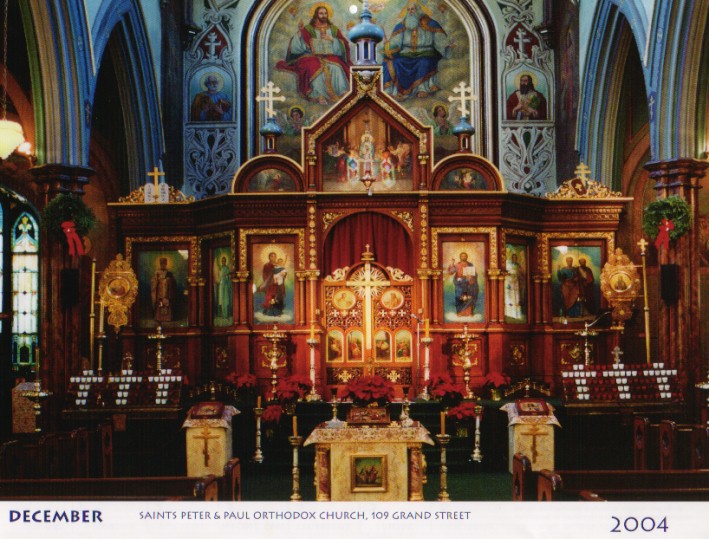
 On Wednesday, NJ.com featured "An Overflowing Bounty of Beauty," the latest entry in the series of architecture columns by John Gomez. The article presents SS. Peter and Paul Russian Orthodox Church (109 Grand Street) in Jersey City, which has recently undergone some renovation.
 Gomez writes:
“The proud parish, readying for its centennial, prepares to look back on the origins of its own story, which began in 1889 when three Slavs - Wasyl Krynicki, Andrej Cislak and Paul Stupinski - established the ‘Sts. Peter and Paul Kranken Unterstutzung Verein of Jersey City,’ a civic and religious ‘brotherhood’ set up to assist Slavic immigrants.”
But those three Slavs were not just Slavs – they were Carpatho-Rusyns. Lemkos, to be precise.
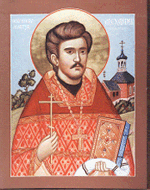
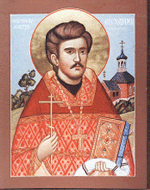 In any case, the church has a long and storied history. After its founding by Lemko Rusyns, it was led by Archpriest Alexander Hotovitsky, a Russian, who was canonized in 1994 as “Missionary to North America and New-Martyr of Russia” (he was killed by the Bolsheviks late in the 1930s after years of persecution). Hotovitsky lived and worked in and around New York from 1895 to 1914, based out of the then-newly-founded St. Nicholas Russian Orthodox parish. He is remembered as a major force in New York City's Slavic history.
  As for the building itself, it was built in 1853 as a Dutch Reformed church in the Gothic Revival style. After it was purchased by the Russian Orthodox parish in 1908, it was renovated to conform to the Orthodox community’s needs. The interior was painted floor to ceiling by Photius Bodasiak, an iconographer from Kyiv, who completed the more than 70s murals that cover the internal walls in just three years, from 1924-1927. On the exterior, onion dome cupolas and Orthodox crosses were added, which were the focus of the recent restoration efforts.
 (Photo from http://www.jerseycityhistory.net/2004calendargallery.html)
10.12.06
Philadephia display includes Rusyn skulls
 Maria Silvestri reports from a fieldtrip to Philadelphia that the Mütter Museum at the Philadelphia College of Physicians has – really – four Rusyn skulls on display.
The skulls are part of a collection used by the Viennese anatomist Doctor Joseph (Jozef) Hyrtl to disprove phrenology, a pseudo-science that claimed that a person’s character and personality (and criminal impulses) could be discovered by feeling bumps on the person’s head.
All four of the Rusyn skulls date from before 1874. They are part of a collection of 139 skulls from around Central and Eastern Europe, and are on permanent display at the museum. Maria jotted down the captions from the four Rusyn skulls:
 Ruthenian
Domarsk Fedko, age 12
Anomaly of dentition
Frontal grooves; defects in tooth enamel
1006.019
Ruthenian
Jakub Mandsink, age 62
suicide
1006.020
Rusniak (from Ruthenia, southern Carpathians)
Fejdku Tisany, age 52
Sharpshooter with the Greek unit from Unghvar.
Maxillary alveolar process recession
1006.100
Ruthenian
Romanov Prasczak, age 21
Died of Cholera in Kharkov, Ukraine
Accessory bone in anterior parieto-temporal
Suture near pterion (left-side), possibly some epipteric bone
1006.103
26.3.03
New York Press: Ukrainian East Village: A Shortened Oral History of an Immigrant Neighborhood
Roksolana Luchkan & Andrey Slivka, Volume 14, Issue 22 - 5/30/2001
Deals with the history of the Ukrainian community of New York�s East Village, which included and still includes many Lemkos and other Rusyns.
Roksolana Luchkan & Andrey Slivka, Volume 14, Issue 22 - 5/30/2001
Deals with the history of the Ukrainian community of New York�s East Village, which included and still includes many Lemkos and other Rusyns.
Subscribe to:
Posts (Atom)




.png)