Showing posts with label serbia. Show all posts

11.7.07

Rock ‘n' Roll in the Backyard

Ivan Sabadoš, Ruski Kerestur, Serbia, Outpost Dispatch #1, October 2003

For you to be as clear as possible about just who Mirko Hornjak Kole is and what Stativa! was, we have to go back at least ten years, to the beginning of the 1990s. That was when the Kerestur punk scene arose from sweat, beer and blood like an unwanted child, sentenced to a stolen life without meaning or perspectives immediately upon birth. Paradoxically, but at the very same moment – possibly the darkest in the recent history of Serbia – an atmosphere was created in which there wasn’t even a trace of authority, control or common sense. This atmosphere helped the punk scene take off.

As if from nowhere, loud, ugly, angry kids flew into the vacuum that is Ruski Kerestur. Insofar as punk defines itself as an allergic reaction to negative socio-economic tremors which, sooner or later, occur in every society, I maintain that our dear Kerestur, at least in this instance, took a step with the rest of the normal world for the first and last time, even if similar things had already happened in the West in the middle of the 1970s. But elsewhere, punk took off even later than in Kerestur. Due to similar circumstances, the highest-quality punk scene in recent years has been in Brazil and Argentina, for example.

This is the way things went in Kerestur: the band YuckFou broke the ice, the Smargel’s broke it a bit further, three or four incarnations of Underwear went even further, and then came the heathen bands ŠMZ and The Aids... The membership of these bands all came from the same roster, with people going from one to the other in quick rotation. The bands, as a rule, fell apart just as soon as they hit on something concrete musically.

There wasn’t much going on, other than failed concerts and a couple demo recordings. The big action was at the public rehearsals, where literally whoever wanted to could get up and play. These quickly developed a cult following. Nobody had any illusions of developing a compact Kerestur punk scene back then. There was no conscious movement, revolt or political action. There was just a narrow circle of people who got together, played and listened to the music they loved. This was how they passed the time, having been chased to the margins of the Turbofolk philosophy dominant in Serbia in those days. Left to its own devices, the punk scene would probably have burnt itself out pretty quickly, leaving no trace.

But in the meantime, a couple of small, unconnected incidents brought about by some teenagers trying to prove themselves – which, as my neighbor Sergej is wont to say, is a normal part of growing up – turned everything upside down. It began with the famous graffiti (“Sex, Drugs and Religious Education,” see photo above) in the center of town, which got a reaction from the village priest immediately, and quickly introduced the punks to the famous Rusyn means of public information.

Overnight, so to say, Kerestur punk found itself in the center of an enormous media whirlwind – for the Rusyn microcosm, anyway.


I still have a couple newspaper articles from that time which were written by people who are now Kerestur’s pundits of political journalism, and the scandal that followed the TV broadcast of “Keresturiada,” the youth evening of the annual Červena Ruža festival, in 1993 in particular stands out.

Something spectacular happened in these articles and features. Kerestur’s punks were described as wild fascists, flying in the face of tradition, drug addicts and Antichrists. It made people uncomfortable, and was a topic of discussion everywhere: in school, in town, on the street...

The whole affair made the hitherto convicts and criminals interesting to the media. Since a hardened mind can’t be changed, and the system can only be controlled from inside, the punks decided not to argue with the media, but to send them articles and songs instead. However much of this is the truth is visible today – just look at who writes two-thirds of the news today…

After all of this, the battle switched to a different front, and the young people of Kerestur, such as they were, finally entered the administration of the local youth center, which enabled them to start putting on concerts. For a brief period in 1996 and 1997, Kerestur was an important point on the R’n’R map of Yugoslavia. In that season, we had visits by several truly premier bands of the YU rock scene at that time: the Lavhanters, Van Gog, Ateist Rep, Opo, Goblini, the Partibrejkers, Rambo... Finally we lucked out and broke out of the anonymous Kerestur countryside. But despite these early successes and numerous contacts, nothing came of any of this. I still don’t know whether it’s because of the already traditional disinterest of Keresturians for everything that goes on in town, or because we lacked ambition, or because we really just weren’t capable. All I know is that we’ll never have a chance like that again... In the meantime, the neighborhood wasn’t sitting back: bands were springing up in the nearby towns of Verbas, Petrovec, Kula… These guys wisely kept to the margins and were eventually able to catch up with the big leagues...

The hero of our story, Mirko Hornjak Kole, was around from the very beginning. Whether in the foreground or the background, he was always there. At poetry evenings, in the bands YuckFou, Šuhajdova, Rektum, Pendrexil... Over time, people came and went (whether they wised up or got fed up), but Kole was always active. I still don’t know where he found so much push and energy!

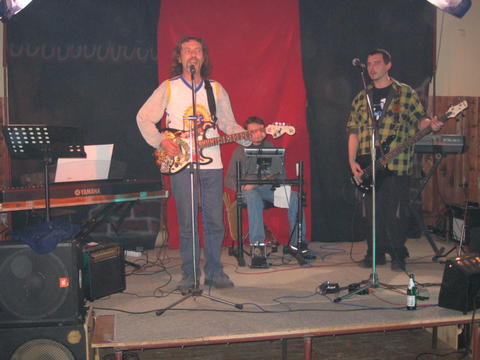
The final “project” which Mirko Hornjak Kole gave the thirsty Rusyn public was called “Stativa!” This was a three-member band in which he played guitar and sang, Zlatan Ruskovski played bass, and Vladan Hardi played drums. After standing still for a long time, the boys from Kerestur somehow were able to take a step beyond all of the other garage bands in the village. That feat was called The Incident of the Naïve Swallow (Slučaj lakovernog detliča) and was presented as a promo— CD in June 2000. It was recorded in Kula in a single afternoon. It has 18 “numbers” and a little more than half an hour of music. Bearing in mind the technical and financial conditions in which it was recorded, the result is just as it should be. Here, it has to be pointed out that Stativa! had a lot of help and support from Dejan Nadj Rokije, who played the drums this time, and from Miko Nadjovi, who made the crazy booklet featuring Pixie, Tesla and Ana Kurnjikova. To define the music that Stativa played is like trying to explain gumbo – everything and anything gets thrown in and it’s impossible to sort it all out in the end. My impression that Kole had intended to put more melodies into the musical legacy of the failing Kerestur scene, music he personally respected and to give everything his own authorial stamp. You’ll agree that this was really an ambitious idea. How much of it did Stativa! realize?

It is immediately apparent, and very troubling that there just aren’t enough original songs. Of the 18 tracks, just three are entirely original –the already antiquated “Antirežimska” (Anti-Regime Song), “Duvanomanija” (Ganga-mania) – which could have wider potential – and “Nebeški Narod” (Heavenly Nation), which really seems like something from Croatian band Hladno Pivo. Then there are three simple-hearted children’s songs, and three Rusyn folk songs, but it’s not worth wasting words on them (other than to point out that my favorite “Njedaljeko od valalu” (Far from the Village) isn’t one of them). The next three tracks (Gazda/The Boss, Andjo/Betrothed and Bubuš/The Monster) are along the lines of the band ŠMZ/SMF. All three together last 18 seconds total, but they’re not bad. There’s a hymn about farms and a blues song, which are solid, and the song “NATO – Zlikovci” (NATO – Criminals), a relic of a time which I hope is just a memory that no one wants to remember. I would say the best moment on the disc is the furious version of “Dijana”, an old hit which sounds like YuckFou played it yesterday. There are also two cover songs, but it really isn’t clear to me why they’re included...

How to conclude? If you take it all and put it together, adding and subtracting, Kole’s dream unfortunately wasn’t realized. The material lacks freshness, the spirit of the time, an attitude which could have given it direction and meaning, a thread which would have connected it to a larger whole. It is missing the balance between desire and possibility. Stativa! remains stuck somewhere at the halfway mark.

[The original Rusyn-language version of this article can be found in the third issue of MAK, at
http://novimak.tripod.com/sabados1.htm.]

26.6.07

2009 Congress will be in Serbia and Croatia

Maramures/Sighetu, 26 June 2007 (RuthenPress) – With a meeting of the newly-elected World Council on Sunday in the Romanian city Sighety, the three-day work of the 9th World Congress of Rusyns ended. The congress gathered more than 80 delegates and around 200 program participants and guests from nine countries of Europe and the North American continent.

Nine representatives of Rusyn organizations were elected to the World Council of Rusyns, and they will hold their posts for two years. For president of the World Council, Dr. Paul Robert Magocsi was elected, and Djura Papuga was elected vice-president. The World Council affirmed the proposal that in 2009 Ruski Kerestur and Petrovci in Croatia will host the 10th World Congress of Rusyns.

Evaluating the work of the 9th Congress and the period since the last congress, Dr. Magocsi pointed out the positive changes in the status and position of Rusyns and particularly pointed out the “vertical ascent in the resolution of the Rusyn question in individual countries of Europe.”

Djura Papuga said that this Congress worked in a tolerant atmosphere which means that many of the misunderstandings of the past have been overcome. He said that at yesterday evening’s meeting of the World Council a text of a resolution was passed that will be finally accepted in two week’s time.

What is interesting is that one of the important points of the future document is stronger cooperation among institutions of higher education with Rusyn language programs – those of Novi Sad (Serbia), Presov (Slovakia) and Krakow (Poland).

25.6.07

Young Rusyn poets win major prize for literature

On Saturday, 23 June, the Dukhnovych Prize was awarded to three young writers from Serbia – Slavko Vinaji, Natalija Ribovic and Ivan Medjesi – for their collection Triolohija (Novi Sad, 2006).


The Dukhnovych Prize is given each year to honor and encourage Rusyn writers. The $1000 award was presented to the three poets at the Ninth World Congress of Rusyns and Third World Forum of Rusyn Youth in Sighetu Marmaţiei, Romania.

Triolohija was published in March 2006 by the youth journal MAK under its MAKoff imprint launched by MAK editor Boris Varga. This was the first book of poetry by young Rusyns in Serbia to appear in 17 years (the three poets are 24, 30 and 30 years of age).

Dukhnovych Prize jury member Elaine Rusinko describes the collection as “
unusual both visually and linguistically, in form and content. The poems are avant-garde in style and express the thoughts of young Rusyns on contemporary themes in a creative use of the Rusyn language. In the work of the three authors there are suggestions of existentialism and the absurd, and the collection as a whole champions poetic freedom. Not every example is successful, but on the whole, the book is a bold attempt that will surely inspire other young Rusyns of all countries.”

Triolohija is not yet available on the internet, but the third book in the MAKoff line, Obecana zem (The Promised Land), is available
here on the internet in .pdf format.

24.6.07

Saturday at the World Congress of Rusyns

Maramorosh/Sighetu, 24 June 2007 (RuthenPress) – The Aleksander Duhnovyc Prize for the best book written in the Rusyn language in the last five years was awarded at the World Congress of Rusyns to three young authors from Serbia.

A three-member jury chose a book of poetry by Natasa Ribovic, Slavko Vinaji and Ivan Medjesi, and jury member Vasilj Homa presented the award Saturday night in Sighetu.

On Saturday, the 9th World Congress of Rusyns worked in five commissions and their chairpeople reported on recent activities. They spent the afternoon working on the text of a resolution of the Congress’s delegates.

Saturday afternoon the World Forum of Rusyn Youth met, at which aside from news on their members’ work two youth organizations, from Croatia and Romania, were accepted as members of the Forum. A new president of the World Forum of Rusyn Youth, Slavko Zagorski of Poland, was also elected.

In the Congress program on Saturday was also the unveiling of a memorial plaque commemorating the nearly 100 Rusyns who in the beginning of the 20th century for religious reasons were arrested and tried by the Austro-Hungarian state.

- I am happy that we are in Romania for the first time and have the opportunity to meet with Rusyns from Maramures and Sighetu who were separated from the other Rusyn communities for a long time. Now we have the opportunity to speak and exchange experiences, President of the World Council of Rusyns Dr. Paul Robert Magocsi told RuthenPress.

The delegates’ Saturday work ended with a proposed Congress resolution that will be adopted today at the final meeting of the 9th World Congress. The decision to hold the 10th World Congress of Rusyns in Ruski Kerestur in 2009 will also be confirmed today.

Today, 24 June, the 9th World Congress of Rusyns ends with a meeting of the newly-elected World Council made up of representatives of Rusyn organizations from nine countries of Europe and North America. Dr. Paul Robert Magocsi was once again elected president of the World Council of Rusyns, and Djura Papuga was elected vice-president.

26.4.07

Summer in Kerestur

The Vojvodina Rusyns’ youth organization Pakt Ruthenorum is organizing ”Summer in Kerestur,” an international summer camp in Ruski Kerestur, Serbia, from 17 to 30 July.

“We want to entice as many young people in Kerestur as possible. Recently, we had the first promotional party for the camp, and soon this will be included in the activities of
Volunteer Center Vojvodina, which is the camp’s main organizer,” Pakt Ruthenorum member Saso Paljenkas told the Rusyn press agency Ruthenpress.

Young people from 15 countries are expected to participate, and the camp will be conducted also in cooperation with local municipalities, institutions and individuals. Participants are not required to stay all 15 days, but are encouraged to participate as much as possible.

If you want more information and you’ve got international long distance, call Vladimir Nad’ Acim at 064-618-21-24 or Igor Varga at 064-183-92-97. Otherwise you can email
Saso Paljenkas.

21.4.07

New MAK website - MP3s, e-books!

MAK, a rare Rusyn pop culture magazine from Novi Sad, recently put up a new website at http://www.ruskeslovo.co.yu/. There are a few issues of the magazine, as well as a forum and other goodies - for example, you can download MP3s from MAK's pop/rock/punk CD, Naj zije Marshall.


MAK's latest book, Obecana Zem (The Promised Land), is also there to be downloaded in .pdf format. The book is a short collection of essays and musings on the idea of a Rusyn promised land.

New symbols for Serbia's Rusyns

On 15 April, the Rusyn National Council in Serbia adopted official symbols for the local Rusyn minority. The coat of arms is the same as that of all Rusyns throughout the world. The flag, however, is the flag of the Republic of Serbia but instead of the Serbian national symbol in the middle, it has the Rusyn symbol. These symbols still have to be promulgated by the government of Serbia, but that process should go smoothly.


Here are some of the rejected proposals:

5.12.06

MAK update

From September 2005 to October 2006, 6 issues of the cultural-political magazine for youth MAK were published in Serbia.

MAK – Mladosc Aktivnosc Kretivnosc (Youth Activity Creativity) is a magazine for young Rusyns in Vojvodina, founded in the early 70s as a magazine for young communists. Today, MAK is one of the rare modern, sub-cultural Rusyn magazines.

In January 2006, MAK published its first sub-culture CD music compilation: "20th anniversary pop-rock music of Voiovodina's Rusyns".

In March 2006, MAK magazine start the literary series "MAKoff" and published its first book in Rusyn, "Triologija" (Triology). It is the first book of poetry by young Rusyns in 17 years.

Contact us:
For MAK subscribtion:
ruske@eunet.yu
Editor:
boris.varga@gmail.com

4.12.06

World Congress Chairman in Washington, D.C.

In Washington, D.C., on 15-17 November 2006, during a three-day visit to diplomatic missions in the United States, chairman of the World Congress of Rusyns, Professor Paul Robert Magocsi, together with a delegation of Rusyn-American community activists, was received by the embassies of Romania, Ukraine, Serbia, and the Vatican. Other members of the delegation were from the Carpatho-Rusyn Society of America: the National Capital Chapter president Dr. Victor Haburchak, vice-president Professor Elaine Rusinko, Dr. Mikulas Popovic, and the president of the society's New England Chapter Orestes Mihaly.

The main purpose of the delegation's visit to the Embassy of Romania was to review plans for the Ninth World Congress of Rusyns, to be held in Sighet (Sighetul Marmatiei) on 21-24 June 2007.

In response to Professor Magocsi's inquiry submitted one year ago about the status of the new bridge across the Tysa River, embassy officials informed the delegation that the formal opening is expected to take place before the end of 2006. This means that it should be possible for delegates from Ukraine to walk across the bridge in order to attend the World Congress. The new bridge will not only link Ukraine and Romania, it will also re-unite Carpatho-Rusyns who live on the northern and southern banks of the Tysa River and who have until now been separated by an international border.

Also under discussion was the topic of official guests at the World Congress. The Romanian Embassy expressed its government's interest in assuring the success of the congress and agreed to assist in issuing formal invitations to official guests who will represent various countries and the European Union at the World Congress.

For the second time within one year the Rusyn-American delegation and the World Congress chairman were received at the Embassy of Ukraine, this time by the Deputy Chief of the Mission, Minister-Counselor Dr. Viktor O. Nikitiuk. Professor Magocsi submitted a formal inquiry to Ambassador Oleh V. Shamshur, which requests clarification about what seems to be Ukraine's contradictory policies toward Rusyns.

On July 7, 2006, Ukraine's Ministry of Justice, in response to an inquiry for recognition of Rusyns as a distinct nationality, replied that "according to international legal norms as well as the laws of
Ukraine, every person has the right to his or her own national self-identity," and that furthermore there is no "official list of nationalities that are recognized in Ukraine." These statements seem to be in contradiction to Ukraine's policies as reflected in its "Proposed Measures for Resolving the Problem of Ukrainians-Rusyns" (1996); its report to the Council of Europe defining Rusyns as a "sub-ethnos of the Ukrainian nationality" (1999), and a published list of nationalities in Ukraine from the country's most recent census (2001) in which Rusyns as a nationality are omitted.

Do the "Proposed Measures for Resolving the Problem of Ukrainians-Rusyns" still reflect the official policy of Ukraine? An answer to that question will determine the tenor of future talks between the World Congress of Rusyns and representatives of the European Union and the United States government.

At the Embassy of Serbia the Rusyn-American delegation had an extensive discussion with that country's ambassador, Ivan Vujacic. Professor Magocsi praised Serbia's wide-ranging support of the Rusyns in Vojvodina, where they are recognized as one of that province's five official nationalities. Of particular concern to the Rusyn-American delegation, however, is whether the present-day government of Serbia still requires a group, for classification as a nationality, to have a so-called mother country (maticna zemlja), that is, an independent state outside Serbia. A formal inquiry on this matter was submitted to the Serbian ambassador by Professor Magocsi.

Should Rusyns "need" a mother country, it logically would be Slovakia or Hungary (since most Vojvodinian Rusyns trace their roots to villages in those present-day countries), but certainly not Ukraine. More to point, Vojvodina's Rusyns do have a historic homeland. It is Carpathian Rus' (popularly referred to as Hornjica), which alongside Flanders, Catalonia, and the Basque Land, is one of the many recognized homelands of stateless peoples in Europe. Historic Carpathian Rus', which is within the borders of several present-day independent states, is the historic homeland of all Carpatho-Rusyns.

At the Embassy of the Vatican, the Rusyn-American delegation and the World Congress chairman were received by the Apostolic Nuncio, Archbishop Pietro Sambi. The Apostolic Nuncio was informed about Carpatho-Rusyns, a distinct nationality in central Europe which is known in Vatican circles as Ruthenians (Ruteni). Most of the discussion focused on the policies toward Rusyns carried out by the Greek Catholic Eparchy of Presov in Slovakia and the Eparchy of Mukachevo in Ukraine. Formally, each of those eparchies emphasizes the use of state languages, Slovak or Ukrainian, at the expense of liturgical Church Slavonic and spoken Rusyn vernacular. As a result of the policies of the Greek Catholic bishops of Prešov and Mukachevo, it seems that the Vatican is following policies similar to that of the former Soviet Union. In other words, the Vatican may note that Rusyns (Ruthenians) are an ethnic group, but it does not recognize Rusyns as a distinct nationality who have their own distinct Rusyn literary language.

Particularly troublesome is the policy of slovakization carried out by the authorities of the Eparchy of Presov and the gradual adoption of the Ukrainian language in the Eparchy of Mukachevo. The Rusyn-American delegation shared with the Papal Nuncio its surprise that the Vatican recently appointed as head of the Byzantine-rite Eparchy of Mukachevo an apostolic administrator, Bishop Milan Sasik, who is a Roman-rite Catholic. Consequently, the Eparchy of Mukachevo in Ukraine's Transcarpathian Region, which is home to many faithful for whom Rusyn is their native and primary language, now has an administrator (bishop) who is an ethnic Slovak and who does not speak Rusyn. Such qualifications would not be problematic if the eparchy were sympathetic to the cultural as well as spiritual needs of its Rusyn flock. The Rusyn-American delegation was heartened to hear the Papal Nuncio express the view that a key requirement in the selection of any bishop is the candidate's understanding of the cultural specificity and ability to communicate in the majority language of the community he is called to serve. Finally, the Papal Nuncio agreed to pass on a request to the Vatican's press and radio service that its reports should in the future not refer to Rusyns (Ruthenians) as Russians.

According to the World Congress Chairman Magocsi, the next series of meetings in Washington, D. C. will be with the Embassy of Croatia, the United States Department of State, and with members of the U.S. Congress who have a special interest in Ukraine.

31.3.03

Novi MAK: Virtuelne Rusnacstvo: Interview with Havrijil Koljesar, RDSA

An interview with Gavrijil Koljesar in which he points out that the internet has made Rusyn-language materials available to Rusyns with internet connections living anywhere in the world. It is a major part of the lives of young Rusyns living abroad who want to maintain contact with their roots. It is one of the Rusyns� � and other small and dispersed groups� � greatest weapons against assimilation.

At Novi MAK
Novi MAK: Rock�n�Roll na Humnje

Ivan Sabado��s �Rock�n�Roll na Humnje,� from MAK�s third issue, discusses Ruski Kerestur�s punk rock movement in the early 1990s.

�Insofar as punk defines itself as an allergic reaction to negative socio-economic tremors which happen at some time or another in every society, I maintain that our dear Kerestur, at least as far as this question goes, at that time for the first and last time took a step with the normal world, although similar events in the west took place already in the middle of the seventies. For example, the last few years the highest quality punk scene has been in Brazil and Argentina,� he writes.

The Kerestur punk scene began with the band YuckFou, followed by bands like SMZ and The Aids. Short-lived bands appeared one after another, involving many of the same performers. Sabado� points out that the scene originated with young people simply having fun, and was �no sort of organized movement, or a revolt or a political act.�

He believes the punks would have lost interest in the music and the scene would have died a natural death quite quickly. However, Sabado� credits the scene�s longevity to the local and Rusyn media, which whipped up a major controversy.

The last great Kerestur punk band was �Stativa!� This band succeeded in releasing a CD, called �Slu�aj lakovernog detlica,� which was recorded in Kula. On the track list were three punk of Rusyn folk songs.

At: Novi MAK
Novi MAK: Novinarstvo na �arno

Mirko Hornjak Kole provides an overview of the development of Rusyn-langauge fanzines in Ruski Kerestur, Kocur and elsewhere in the Vojvodina.

At Novi MAK
Novi MAK: U Meno Naroda

Aleksandra Dudas�s extensive article �U Meno Naroda� thrusts Rusyns� attitudes towards sex into the spotlight. She sought out comments from an entire spectrum of people � from the 28 year old editor of Dečko to the 42 year old director of the Ruske Slovo publishing house to a 64 year old writer and a 72 year old lawyer.

Аt Novi MAK

26.3.03

Kerestur's United Party

YUGOSLAVIA, 3 June 2002. Ruski Kerestur's Rusyn and Ukrainian groups joined forces on 10 May to host the United Party, an invitation-only cocktail party designed to show that the two groups can rise above their differences and cooperate towards common goals. More than 50 people attended the party, which lasted until 4 a.m.

Five groups joined in: Ruska Matka's Youth Forum, the youth group of the Union of Rusyns and Ukrainians (Sojuz), the magazines MAK and Time Out and a brand new organization called Teledom Ruthen.

Despite its name, Teledom Ruthen has nothing to do with television. It is a small network of cultural centers in villages and smaller towns. The centers offer such services as internet access, foreign language classes and theatre workshops.

Cocktail parties are rare enough in Kerestur, but what was even more interesting were the cocktails' names: Matka and Sojuz mix, MAK Hurricane , Rusyn National Poison...

The party also honored MAK, which began publication last September. Ruski Kerestur's Rusyns and Ukrainians hope to build on the success of the United Party with further joint actions.
Ruske Slovo: From the Editor: To Know, and To Be Able

In his letter from the editor, Ljubomir Rama� takes up two issues chairman of the Commission for Information of the Skup�tina (Assembly) of the AP Vojvodina �or�e Suboti� recently pointed out concerning the media: the need to involve more young people in the media, and self-censorship among journalists.

On the surface, the first problem is not so urgent in the Rusyn-language media. Young Rusyns are clearly interested in journalism, as evidenced by the enormous response to the recently-founded Novi MAK. However, Ruske Slovo (and other media outlets throughout the province) are finding it impossible to hire "young blood" due to a lack of funding. The majority of Vojvodinian minority media is funded by the provincial Skup�tina.

Turning his attention to self-censorship, Rama� writes that this is a "remnant of recent times" which is "difficult to correct" in journalists who have been working in the field for decades. It is worthwhile to point out self-censorship among journalists is a problem common to virtually all Central and Eastern European societies in transition.

However, Ramač sees the two issues as being intertwined. Training young people in the ways of "real" journalism will not only get them more involved in the media, but will also offer a major opportunity to combat self-censorship, since training new journalists is easier than trying to break the bad habits of older ones. However, none of this is possible without additional funding.
Ruske Slovo: Author of a Site Linking Rusyns around the World

Aleksander Palancanin interviews Miroslav Siladij of Verbas, who runs the website
Atila Kova�

After Andy Warhol, the best-known gay Rusyn is quite possibly Atila Kova�, who made news in Yugoslavia and throughout Eastern and Central Europe in the fall of 2001 when he launched De�ko, Serbia�s first monthly mainstream gay magazine.

Kova�, who is of Rusyn and Hungarian ethnicity, has become better known to Serbia's Rusyn community primarily through the magazine Novi MAK, which ran an interview with him in its second issue.

He holds a degree in theatre, film, radio and television directing from the University of Novi Sad. Among his professional experience is work with operas and theatres in Novi Sad, and five years spent with TV Novi Sad. In January 2000, he was among the organizers of the first conference on sexual minorities in Yugoslavia.

Interview with Kova� in Serbian

and another in Rusyn

and an article about De�ko from Transitions On Line.
Former Yugoslav Rusyn Media: Novi MAK

Young Rusyns in the Vojvodina run this magazine, which frequently covers pop culture topics.

Visit Novi MAK