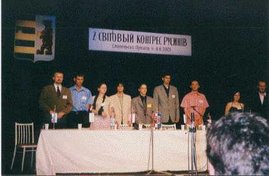
Uzhgorod, July 16, Interfax - The Ruthenians oppose plans to set up American NMD in Rovna and Stoj planes, the Ruthenian leader Archpriest Dimitry Sidor, speaker of the Sojm (Ruthenial national assembly) and rector of the Holy Cross cathedral in Uzhgorod, said.
'Most Ruthenian groups decided to campaign for declaring Transcarpathia demilitarized zone, where only hotels and sanatoriums may be built,' Fr. Dimitry told Interfax.
He said that in 1980s he protested against large radar constructed near Mukachevo, Transcarpathian Region.
'But how could I predict that Americans would come to replace the Soviets with their military bases!' he said.
Commenting the schism of the Orthodox Church in Ukraine, the speaker of the Ruthenian Sojm said that the Ukrainian people 'really valued their belonging to the canonical Orthodoxy' and would never leave the Ukrainian Orthodox Church of the Moscow Patriarchate 'regardless of any political processes in Ukraine.'
'The Ruthenians consider Filaret's schismatics as cultist who may be accepted into the Church only if they repent,' he said.
The Ruthenian language, he added, is very close to the Church Slavic, 'so we do not have the worship-language problem that is known in Russia and especially in Ukraine.'
Showing posts with label transcarpathia. Show all posts
Showing posts with label transcarpathia. Show all posts


13.7.07
Mixed messages from Minority Committee Head
 13.07.2007 Zakarpattja.net
Ukrainian legislation does not allow recognition of the Rusyns of Transcarpathia as a separate nationality. The head of the State Committee on Matters of Nationality and Religion Heorhij Popov said at a press conference in Kyiv.
"Our Ukrainian legislation, I answer as the head of a state organ, does not define who constitutes a nationality, in what fashion, etc.," he said.
At the same time, Popov confirms that Rusyns can hold the status of national minority.
"The matter will have to be reviewed when it comes time to hold the next census. But we do not have any other mechanism. Only in the context of the census, when the law on the census is adopted and a decision is made, is a list of nationalities drawn up," he said.
Popov did not specify when the next population census will be held in Ukraine. Aside from that, the head of the State Committee on Matters of Nationality and Religion expressed doubts in the real necessity of the Rusyns receiving the status of national minority, according to "Novyj Rehion."
"This is more of a political-cultural step," he thought.
It is to be recalled that earlier the Ukrainian Ombudsman Nina Karpachova requested that the government recognize the Rusyns as a separate nationality.
27.6.07
Ukraine's Ombudsman for Human Rights for recognizing the Rusyns
Anna Romanenchuk, 27 June 2007
 Ukraine's Ombudsman for Human Rights, Nina Karpachova, is supporting the position of deputies of the Provincial Rada on the Rusyn question, which has become significant to many Transcarpathians.
As Zakarpattja Online has already reported, having taken into account the wishes of the residents of Transcarpathia, the Transcarpathian Provincial Rada on 7 March this year passed a resolution on the recognition on the territory of the province a "Rusyn" nationality, which provoked considerably polarized emotions.
Some maintain that the step taken by the Provincial Rada deputies is democratic; others that the matter is far from settled. And in a matter of days it became known that the Ombudsman for Human Rights of the Verkhovna Rada (national parliament) of Ukraine, Nina Karpachova, during a meeting with the head of the World Council of Rusyns Paul Magocsi - also attended by Yevhen Zhupan of the Transcarpahia Provincial Rada, himself the most active initiator of the recognition in Transcarpathia of the "Rusyn" nationality - announced that in the course of recent years she had received many appeals from residents of Transcarpathia concerning the fact that the state was ignoring their right to freely choose and revive their nationality.
Nina Karpachova said that such discrimination must be halted, and that she has turned to the Head of State Viktor Yanukovych and presented him with the task of reviving the nationality "Rusyn" in Ukraine, entering the Rusyns into the registry of nationalities of Ukraine, and also requesting that central and local organs of the executive authority be obliged to create the conditions to fulfill the ethno-cultural and social needs of Rusyns in Ukraine.
As Yevhen Zhupan noted to the press service of the Provincial Rada, Paul Magocsi presented Karpachova with his book "The People from Nowhere" (an illustrated history of the Carpatho-Rusyns) on 18 June at the Kievo-Pechersk Monastery, and told her that he highly values the efforts of the Ukrainian Ombudsman towards the recognition of the Rusyn nationality in Ukraine. Further, as this question affects the rights of thousands of people who live today in Transcarpathia. Nina Karpachova said that in the course of recent years she has received a number of appeals from residents of Transcarpathia who identify as Rusyns and she shares their concerns regarding the fact that the Ukrainian state is ignoring their right to freely choose and revive their nationality. She belives this discrimination was not halted in 1945, and that freedom of ethnic self-identification and development is enshrined in the constitution of Ukraine, various Ukrainian laws, international conventions and declarations.
 The Ombudsman for Human Rights pointed out that the Rusyns, as the indigenous residents of the Carpathian region, are intrinsically a unique culture, with a language recognized by international Slavicists, a full ethnic character, traditions, spirituality, mentality, sense of their nationality. Yevhen Yevhenovych further pointed out that today in the Transcarpathina province there are 27 Sunday schools active, where Rusyn language, literature and culture are taught. In the region, Rusyn writers and artists work fruitfully. Rusyn newspapers also appear. During the years since the independence of Ukraine there have been nearly 40 books published in the Rusyn language, particularly "The History of Subcarpathian Rus'", "Rusyn Pedagogical Encyclopedia," and the "Rusyn-Ukrainian-Russian Dictionary," and the Gospels have also been translated into Rusyn.
Rusyns are making considerable contributions to the development of science, culture and other spheres of life in our Ukraine.
According to Nina Karpachova, the Rusyn ethnos must be revived on the territory of Ukraine and granted its rights. An civil initiative by Carpatho-Rusyn organizations as of 1 June has collected more than 130,000 signatures of Transcarpathians who consider themselves to be Rusyns.
 Ukraine's Ombudsman for Human Rights, Nina Karpachova, is supporting the position of deputies of the Provincial Rada on the Rusyn question, which has become significant to many Transcarpathians.
As Zakarpattja Online has already reported, having taken into account the wishes of the residents of Transcarpathia, the Transcarpathian Provincial Rada on 7 March this year passed a resolution on the recognition on the territory of the province a "Rusyn" nationality, which provoked considerably polarized emotions.
Some maintain that the step taken by the Provincial Rada deputies is democratic; others that the matter is far from settled. And in a matter of days it became known that the Ombudsman for Human Rights of the Verkhovna Rada (national parliament) of Ukraine, Nina Karpachova, during a meeting with the head of the World Council of Rusyns Paul Magocsi - also attended by Yevhen Zhupan of the Transcarpahia Provincial Rada, himself the most active initiator of the recognition in Transcarpathia of the "Rusyn" nationality - announced that in the course of recent years she had received many appeals from residents of Transcarpathia concerning the fact that the state was ignoring their right to freely choose and revive their nationality.
Nina Karpachova said that such discrimination must be halted, and that she has turned to the Head of State Viktor Yanukovych and presented him with the task of reviving the nationality "Rusyn" in Ukraine, entering the Rusyns into the registry of nationalities of Ukraine, and also requesting that central and local organs of the executive authority be obliged to create the conditions to fulfill the ethno-cultural and social needs of Rusyns in Ukraine.
As Yevhen Zhupan noted to the press service of the Provincial Rada, Paul Magocsi presented Karpachova with his book "The People from Nowhere" (an illustrated history of the Carpatho-Rusyns) on 18 June at the Kievo-Pechersk Monastery, and told her that he highly values the efforts of the Ukrainian Ombudsman towards the recognition of the Rusyn nationality in Ukraine. Further, as this question affects the rights of thousands of people who live today in Transcarpathia. Nina Karpachova said that in the course of recent years she has received a number of appeals from residents of Transcarpathia who identify as Rusyns and she shares their concerns regarding the fact that the Ukrainian state is ignoring their right to freely choose and revive their nationality. She belives this discrimination was not halted in 1945, and that freedom of ethnic self-identification and development is enshrined in the constitution of Ukraine, various Ukrainian laws, international conventions and declarations.
The Ombudsman for Human Rights pointed out that the Rusyns, as the indigenous residents of the Carpathian region, are intrinsically a unique culture, with a language recognized by international Slavicists, a full ethnic character, traditions, spirituality, mentality, sense of their nationality. Yevhen Yevhenovych further pointed out that today in the Transcarpathina province there are 27 Sunday schools active, where Rusyn language, literature and culture are taught. In the region, Rusyn writers and artists work fruitfully. Rusyn newspapers also appear. During the years since the independence of Ukraine there have been nearly 40 books published in the Rusyn language, particularly "The History of Subcarpathian Rus'", "Rusyn Pedagogical Encyclopedia," and the "Rusyn-Ukrainian-Russian Dictionary," and the Gospels have also been translated into Rusyn.Rusyns are making considerable contributions to the development of science, culture and other spheres of life in our Ukraine.
According to Nina Karpachova, the Rusyn ethnos must be revived on the territory of Ukraine and granted its rights. An civil initiative by Carpatho-Rusyn organizations as of 1 June has collected more than 130,000 signatures of Transcarpathians who consider themselves to be Rusyns.
13.6.07
Rusyns Recognized as Indigenous Nationality of the Transcarpathian Oblast of Ukraine
Decision is a Milestone in Decades-Long Struggle of National Minority Group
 Washington, D.C., May 31, 2007 – A landmark decision of Ukraine’s Transcarpathian Oblast Council on March 7, 2007, officially recognized the Rusyn people as an indigenous nationality of the region. The council members, representing the oblast’s 1.2 million citizens, voted overwhelmingly to respond to the long-standing requests of local cultural and political organizations to acknowledge the existence of a distinct Rusyn nationality in the Transcarpathian (Zakarpatska) oblast. The 90-member council voted as follows: 71 for; 2 against; with 2 abstentions.
Rusyns are an East Slavic people living primarily in the Carpathian Mountain region of Slovakia, Poland, Romania, and Ukraine. Sizeable Rusyn communities also exist in Serbia, Croatia, Hungary, Canada, and the United States. Rusyns are officially recognized in all of those countries except for Ukraine.
The territory of Transcarpathia (historic Subcarpathian Rus’) was a semi-autonomous province of Czechoslovakia until after World War II, when Stalin annexed the territory and outlawed the idea of a distinct Rusyn nationality. Rusyns were declared to be Ukrainians, a condition that has continued in independent Ukraine to the present. In spite of the fact that the 2001 Ukrainian census did not include Rusyn as a national category, 10,100 individuals identified themselves as Rusyn rather than Ukrainian. Today Rusyns comprise approximately 65% of the population of Transcarpathia, that is, 800,000-850,000 people.
Valeriy Padiak, president of the Uzhhorod branch of the Aleksander Dukhnovych Society, a cultural organization of Rusyns, immediately praised the decision as a significant positive step forward. Rusyn organizations in Transcarpathia will now look for government support of Rusyn “Sunday schools,” the establishment of a department of Rusyn language and culture at Uzhhorod National University, support for publications, conferences and celebrations of Rusyn traditional culture, Rusyn programs on television and radio, and the introduction of Rusyn language and history as elective subjects in public schools.
 Washington, D.C., May 31, 2007 – A landmark decision of Ukraine’s Transcarpathian Oblast Council on March 7, 2007, officially recognized the Rusyn people as an indigenous nationality of the region. The council members, representing the oblast’s 1.2 million citizens, voted overwhelmingly to respond to the long-standing requests of local cultural and political organizations to acknowledge the existence of a distinct Rusyn nationality in the Transcarpathian (Zakarpatska) oblast. The 90-member council voted as follows: 71 for; 2 against; with 2 abstentions.
 The decision to recognize Rusyns as distinct from Ukrainians means that the oblast must now provide funding for the needs of the Rusyn community in areas of language, culture, and education alongside funding for other nationalities in the region, such as Hungarians, Romanians, Slovaks, Roma, and Germans. The Transcarpathian Oblast of Ukraine, which borders Poland, Slovakia, Hungary, and Romania, is home to over 100 nationalities and peoples.
Rusyns are an East Slavic people living primarily in the Carpathian Mountain region of Slovakia, Poland, Romania, and Ukraine. Sizeable Rusyn communities also exist in Serbia, Croatia, Hungary, Canada, and the United States. Rusyns are officially recognized in all of those countries except for Ukraine.
The territory of Transcarpathia (historic Subcarpathian Rus’) was a semi-autonomous province of Czechoslovakia until after World War II, when Stalin annexed the territory and outlawed the idea of a distinct Rusyn nationality. Rusyns were declared to be Ukrainians, a condition that has continued in independent Ukraine to the present. In spite of the fact that the 2001 Ukrainian census did not include Rusyn as a national category, 10,100 individuals identified themselves as Rusyn rather than Ukrainian. Today Rusyns comprise approximately 65% of the population of Transcarpathia, that is, 800,000-850,000 people.
Paul R. Magocsi, Chairman of the Slovakia-based World Council of Rusyns, remarked, “The decision of the Transcarpathian Oblast Council is a reflection of the success of the Rusyn movement and all those who have worked on behalf of the Rusyn nationality both inside and outside Ukraine.” Magocsi’s enthusiastic reaction was echoed by Rusyn organizations in other countries of central Europe.
Valeriy Padiak, president of the Uzhhorod branch of the Aleksander Dukhnovych Society, a cultural organization of Rusyns, immediately praised the decision as a significant positive step forward. Rusyn organizations in Transcarpathia will now look for government support of Rusyn “Sunday schools,” the establishment of a department of Rusyn language and culture at Uzhhorod National University, support for publications, conferences and celebrations of Rusyn traditional culture, Rusyn programs on television and radio, and the introduction of Rusyn language and history as elective subjects in public schools.
Local Rusyn leader and deputy to the Transcarpathian Oblast Council Ievhen Zhupan welcomed the recognition, stating that since 1992 the Oblast Council has requested the recognition of Rusyns as a distinct nationality in Ukraine four times, adding, “Unfortunately, today Ukraine is still the only country where Rusyns have no official status.” He called attention to the fact that Rusyns and Rusyn organizations supported democratic change in Ukraine during the Orange Revolution. According to Zhupan, “Transcarpathians will continue to build up their region, support their country of Ukraine, love their native land, and live in peace with others, regardless of their ethnic background.”
The Oblast Council has said that it will refer the matter of nationwide recognition of Rusyns in Ukraine to Ukraine’s national parliament (Verkhovna Rada), requesting that the parliament take the final step in the matter and legally recognize the existence of the Rusyn people countrywide. Such nationwide recognition would demonstrate Ukraine’s commitment to democratic principles and conformity with European norms.
30.11.06
RFE/RL: Ukraine: Transcarpathian Rusyns Want Official Recognition
 PRAGUE, September 22, 2006 (RFE/RL) -- Last week the Transcarpathian Oblast Council appealed to Ukraine's president, prime minister, and parliamentary speaker to grant Rusyns in the region an official status of ethnic minority (nationality).
Rusyns, who live in a more or less compact territory in Ukraine, Slovakia, and Poland, are officially recognized as a minority by Bratislava and Warsaw, while Kyiv considers them to be a Ukrainian subgroup. Their struggle for official recognition in Ukraine has continued for more than 15 years now.
Similar appeals to grant official recognition to Rusyns in Ukraine were already issued by the Transcarpathian Oblast Council in 1992 and 2002. But official Kyiv ignored them.
Will the situation repeat itself this time too?
Activists of the People's Council of Transcarpathian Rusyns (NRRZ), an umbrella organization claiming to represent the interests of all Rusyns in the oblast, believe that it will not.
Rusyns In High Places
There are at least two reasons for their optimism.
First, after President Viktor Yushchenko came to power and political life in Ukraine became more democratic, Rusyns in Transcarpathia managed to organize several cultural events with official support and to present their cause on local television, where they were allowed to speak in their mother tongue. This year Rusyns also opened 26 Sunday schools instructing in the Rusyn language and culture.
Second, the Rusyn movement now seems to have an advocate with meaningful political leverage in Kyiv -- Viktor Baloha, former Transcarpathian governor and former emergency situations minister. Baloha -- a councilor of the Transcarpathian Oblast Council, who backed last week's appeal for the official recognition of Rusyns -- was recently appointed by President Yushchenko as head of the presidential staff.
NRRZ deputy head Fedir Shandor tells RFE/RL's Ukrainian Service that a nationality status for Ukraine's Rusyns would considerably boost their efforts toward developing their linguistic and cultural heritage, which they see as distinct from Ukrainian.
"According to the census in December 2001, 10,069 people [in Transcarpathian Oblast] declared themselves to be Rusyn. Thus, even despite the fact that such a nationality is not in the [official] register, there are people considering themselves to be of Rusyn nationality," Shandor says.
According to Shandor, the most urgent tasks for Transcarpathian Rusyns include launching a regular television program in the Rusyn vernacular, establishing a chair of Rusyn studies at a university in Uzhhorod, the capital of Transcarpathian Oblast, and working out a standardized version of the written Rusyn language.
Some estimates say there may be as many as 1.5 million people of Rusyn origin, first of all in Ukraine, Slovakia, Poland, the United States, and Canada. But their Rusyn identity is generally weak, primarily because Rusyns have never had their own state or political independence.
Complicated History
The history of Rusyns -- East Slavic inhabitants of the Carpathian Mountains -- is quite convoluted and subject to many scholarly controversies.
Throughout the 19th century and until World War I, when overwhelmingly rural and agricultural Rusyns produced their own intelligentsia and articulated the idea of their ethnic distinctiveness, their fatherland -- Transcarpathia (Carpathian Rus) -- belonged to the Austro-Hungary.
After World War I and the breakup of the Austro-Hungarian state, most of Transcarpathia found itself within the borders of Czechoslovakia, where Rusyns enjoyed a sort of self-rule with their own governor, schools, a national anthem, and a national theater.
After World War II most of Transcarpathia was annexed by the Soviet Union, which did away with the idea of Rusyn distinctiveness and declared all Rusyns to be Ukrainians. The communist regimes in post-World War II Czechoslovakia and Poland adopted the Soviet line and also decreed that Rusyns within their borders were Ukrainians.
Rusyns reemerged after the collapse of the communist system in Poland and Slovakia and the breakup of the Soviet Union.
A census in Slovakia in 2001 registered 24,000 Rusyns, up from 17,000 Rusyns registered in a census 10 years earlier. A census in Poland in 2002 found that there were 6,000 Lemkos (local name for Rusyns) in the country.
The officially established numerical strength of Rusyns is not particularly impressive but the general trend seems to be propitious for them -- having started from nil, Rusyns continue to gain in number.
Shandor believes that the official unwillingness to grant recognition to Rusyns tarnishes Ukraine's international image.
"It is very important for Ukraine to register this nationality, in order to avoid various manipulations at the level of the European Union," Shandor says. "There is a league of unrepresented peoples [the Unrepresented Nations and Peoples Organization], which creates a negative image for Ukraine in connection with the fact that the Rusyn nationality is not recognized."
According to a final document of the meeting of the Conference on Security and Cooperation in Europe in Copenhagen in 1990, "to belong to a national minority is a matter of person's individual choice." Moreover, the document says that "persons belonging to national minorities can exercise and enjoy their rights individually as well as in community with other members of their group."
But many Ukrainians, including intellectuals and academics, would argue whether European standards could be applied to Rusyns in Ukraine. One of them is Mykola Zhulynskyy, director of the Institute of Literature in Ukraine's National Sciences Academy.
"I think that in this case the European experience is of no use. This is simply a big problem that arouse in connection with the fact that Ukraine had not been united, that she had been torn apart by different empires. [The Rusyns constitute] the indivisible Ukrainian body," Zhulynskyy says.
However, historical arguments can also be used to question Zhulynskyy's reasoning, if not to discard it altogether. No later than a century ago many Russians used to argue in almost the same way, asserting that Ukrainians ("Little Russians") and Belarusians ("White Russians") constituted "the indivisible Russian body."
Now that Ukrainians have an independent state, do they really need to behave toward their own "younger brothers" -- Transcarpathian Rusyns -- like their erstwhile oppressor, tsarist Russia, behaved toward them?
(RFE/RL's Ukrainian Service correspondent Nadiya Petriv contributed to this report.)
Subscribe to:
Posts (Atom)