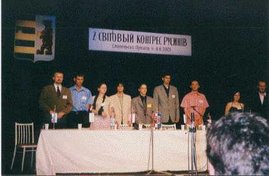
Paul Robert Magocsi, Chairman
Sighet, Romania, 22 June 2007
May I begin by asking all of us to stand and observe a moment of silence for two of our members who have left this earthy life since our last congress in 2005: Vasyl’ Turok, former chairman of the Rusyn Renaissance Society in Slovakia and the first chairman of the World Congress of Rusyns; and Mikhal Varga, former chairman of the Ruska Matka Society in Serbia and long-time member of the World Council of Rusyns.
My report to you as chairman of the World Congress of Rusyns will consist of three parts. The first part will review the work of the World Council since the last Congress. The second part will discuss some of the problems faced by the World Congress. The third part will address what I consider some of the most important tasks to be undertaken in the next two years and beyond.
The work of the World Council, 2005-2007
Since the last congress, the World Council of Rusyns met three times: in Ruski Kerestur (September 2005); Krynica (May 2006); and Sighet (February 2007). I am pleased to report that at the Krynica and Sighet meetings all members of the World Council were present, which reveals the degree of commitment that council members have toward the World Congress. I should also note that your chairman met individually with the representatives of the national organizations in Serbia, Poland, Hungary, Romania, the United States, Ukraine, as well as with the two associations that now comprise the delegation from Slovakia.
The Resolutions of the Eighth World Congress adopted in Krynica 2005 outlined seven tasks for the World Council and its chairman. I am pleased to report that five of the seven tasks were addressed. The council’s executive secretary, Aleksander Zozuliak created an Internet website for the World Congress of Rusyns. For the first time since its creation in 1991, the World Congress has established official contacts with the governments of all countries where Rusyns live. For the moment, we have concentrated our work in two capitals: Washington, D.C. and Kiev. Together with a delegation of Rusyn-Americans, your chairman was received on two separate occasions by nine embassies in Washington, D. C.—those of the Czech Republic, the European Union, Hungary, Poland, Romania, Serbia, Slovakia, Ukraine, and the Vatican. We actually met at the embassies of Romania and Ukraine twice. In all cases we were received by an ambassador, Papal Nuncio, or the ranking representative of a given embassy. In the case of Serbia and Ukraine, we left written inquiries, the texts of which were subsequently published in the World Congress journal, Rusyn.
Aside from embassy visits, Rusyn-American members of organizations represented in the World Congress met with officials at the U.S. State Department and with several U.S. congressmen, including the head of the congressional caucus for Ukraine and an influential member of the Senate’s Foreign Relations Committee, Senator John McCain. In all cases, our concerns—positive as well as negative—were transmitted to the governments of the above countries, and in the case of Senator McCain, via a direct intervention with President Iushchenko of Ukraine. Such lobbying work will continue in Washington, D.C., especially our efforts to encourage the United States Congress to express its concern about the status of Rusyns in Ukraine. Members of the World Council should also take the initiative to set up meetings for the World Congress chairman with government officials of their respective countries in Warsaw, Bratislava, Budapest, Belgrade, Bucharest, etc.
In February 2007, the chairman of the World Congress also met in Uzhhorod with officials of the Transcarpathian Regional Council and Administration, to whom he delivered a memorandum urging the recognition of Rusyns as a distinct nationality in Ukraine. Although there was no linkage between that visit and what was to follow, it is true that within two weeks, on March 7, the Transcarpathian Regional Council passed, virtually unanimously, a resolution that recognizes Rusyns as a distinct nationality in Transcarpathia and has called on the central government to do the same for all of Ukraine. At this time I wish to express our deep appreciation for the efforts of Rusyn activists in Transcarpathia—whether or not they are at present formally associated with the World Congress—for helping make possible this public recognition of Rusyns as a distinct nationality. Most recently—this very week—I as chairman of the World Congress (together with a delegation of Rusyns from Transcarpathia and Canada) met in Kiev with the ambassadors to Ukraine from the European Union and the United states, as well as with the Ombudsman of Ukraine.
As a result of lobbying activity in the capital of Ukraine and the United States our World Congress has, in effect, become recognized as the voice of Rusyns to the outside world. This is a responsibility that we must guard with care.
Another task assigned to the World Council and its chairman is to assist in the organization of the Third International Congress of the Rusyn Language. As if this congress in Sighet were not enough, we are holding yet another congress this year, the Third Rusyn Language Congress, which will take place in Cracow, Poland in September 2007. Thanks to the intervention of Dr. Olena Duts’-Faifer, the language congress is being co-sponsored by our World Congress, the Rutenika Foundation, and the Pedagogical University in Cracow (Akademia Pedagogiczna). It will be the largest Rusyn language congress to date, with 30 speakers, 40 teachers, and 10 guests from twelve countries.
On a more prosaic note, the World Council and, in particular, its chairman, was given the task to resolve the problem of representation from two countries, Hungary and Slovakia. In keeping with an earlier resolution of the World Congress, which stated that its founding national members should, wherever possible, be made up of a federation or council of organizations instead of a single organization, we succeeded—after some effort—in having Hungary and Slovakia follow the earlier example of Ukraine and the United States; namely, Hungary is now represented by the Association of Rusyn Organizations in Hungary, and Slovakia by the Rusyn Renaissance Society and the Slovak Association of Rusyn Organizations.
Although not on the formal agenda of the World Congress, your chairman has also served as the North American coordinator to raise funds for Rusyn-language schools in Europe. For the past four years we have raised money to make possible four Rusyn-language classes in Slovakia. Even more impressive is what we have been able to achieve in Transcarpathia in cooperation with Mr. Vasyl’ Sarkanych and a few other World Congress delegates from Ukraine who are simultaneously members of the Rusyn School Board in Transcarpathia. Four years ago the program began with 8 “Sunday schools”; each year the number has risen, so that the present 2006-2007 school year has 27 Rusyn classes spread throughout Transcarpathia. Our thanks go not only to the Transcarpathian School Board but also to individual donors in the United States and Canada (of Rusyn as well as non-Rusyn background) whose generous financing has made Rusyn-language education possible in historic Subcarpathian Rus’.
Problems to be addressed
The second part of the chairman’s report is, as I said at the outset, concerned with problems. I believe the World Congress of Rusyns is in crisis. On the one hand, many of us continue to have ever greater expectations and demands for the congress, and one would hope that they could be carried out by some of the new faces we see among some national delegations. On the other hand, the congress has a serious lack of cadres. What I mean is a lack of persons who can actually do concrete things. Perhaps the most serious problem is in the World Council itself.
For example, while the last World Congress called for an Internet site, it also called for the creation of the calendar of events. Of the nine members of the World Council, at most two provided such information. Since the chairman is expected to meet with government officials in each country where Rusyns live, in order to prepare for such work he asked on several occasions for each World Council member to provide two main issues that face their respective Rusyn communities. Of the nine World Council members, only three provided information. We also asked each World Council member to provide a list of all organizations from their respective country that are associated with the World Congress. This request applies to six countries—only one replied. This very Ninth World Congress in Sighet has at least number of folklore groups from abroad as participants in the cultural program. Why? For example, Ukraine—just across the river—was allotted the largest proportion of performance time. Our hosts from Romania even found funding to provide meals for 100 guests from Ukraine to participate and perform on Saturday. However, there will be no performers or guests from Ukraine, simply because no arrangements were made for them to come here, even though there was four months’ lead time since our last World Council meeting to make the necessary arrangements. There are several other examples that could be mentioned, but I am sure there are already some of you in the audience who would accuse me of washing our dirty laundry in public. But these are serious issues, and if they are not resolved I do not see how the World Congress can continue to function.
When asked—as I am asked—what it takes to be the head of a national delegation to the World Congress, I answer that one has first and foremost to be a secretary. And I do not mean a general secretary as in the old Communist parties, or an executive secretary of a business corporation with access to a large staff. What I mean is a secretary-like person who is willing and able to do tedious organizational work and—most importantly—meet deadlines set by the World Council’s Executive Secretary. At this point, I think it appropriate to recognize that in large part the World Congress has throughout its entire fifteen years of existence has been able to function because of the incredible coordinating work carried out by Aleksander Zozuliak. Sasha is unpaid, has no vote, and basically carries out what he is told by the World Council members and chairman. And this is the same person that at the last World Congress some participants wanted to remove from the post.
Tomorrow afternoon, the mandate of each of us as a member of the World Council expires. I trust that each national delegation will chose someone it considers its most responsible representative. In turn, I urge that each nominee accept the nomination only if he or she is prepared to as an efficient secretary-like organizer. This qualification applies as well to whomever is chosen as the new chairman.
Tasks for the future
Thirdly, and lastly, what about the future? What should be the main concern of the World Congress and its national organizations for the next two years and beyond? I believe there are two main concerns—schools and the census. I do not believe it needs repeating that the future of Carpatho-Rusyns as a nationality depends on young people who know the Rusyn language and who, in particular, have a clear sense that Rusyns form a distinct nationality, even though they may not have their own state. We know that some degree of formal schooling is the only way to assure linguistic and cultural-historical awareness. I call upon each national organization to formulate a strategic plan, whose goal would be to increase the number of Rusyn language elementary classes, guarantee the availability of quality textbooks, and assure that there is adequate teacher training at the university level.
Certainly, there have been certain very important achievements during the past several years in each of these areas, but much more needs to be done. For example, in Poland there exists a division for the Lemko-Rusyn language and culture at the Akademia Pedagogiczna in Cracow. From time to time, the very existence of that division is threatened because of internal university politics and, at times, a lack of students. Why does not the Stovaryshŷnia Lemkiv and other Lemko organizations in Poland make teacher-training one of its priorities by working to create not only a division, but an institute, or even katedra—and on a permanent basis? In Slovakia, the problem seems to be reversed. The Slovak government and Prešov University have made possible a stable teacher-training program at the university level. But where are the schools? There are in Slovakia at most only twelve schools where the Rusyn language is taught. That number has basically not changed since the program began functioning in 1999. Worse still, in four of these schools the salary of the teacher is not paid for by the school itself, but by donations from Rusyns in the United States. Why so few classes? And why must some classes be supported from abroad? It seems that Rusyns in Slovakia spend more time—-and money—on suing each other in court over control of the Ruský Dom in Prešov, or over who has the right to use a name for a particular newspaper or journal. What a waste! Why not direct one’s individual and organizational energies to a better purpose; that is, the systematic—not one time—work in villages to convince parents that their children should have access to education in their native language, Rusyn, as a required—not optional—subject.
In Transcarpathia there is an ever growing number of schools, but they depend exclusively on outside funding, which next year will cost $20,000. How long can such annual subsidies from Rusyns in North America continue? Has any thought been given to alternative solutions? Rusyn organizations in Transcarpathia have called for a katedra of Rusyn Studies at the University of Uzhhorod. But has any thought been given to how that is to occur? For example, a katedra of Rusyn Studies could be created relatively easily. But what about the teaching program? How can one be certain that the teaching staff will present Rusyns and their language not as a distinct people but as an ethnic group of Ukrainians and their speech a dialect of Ukrainian? And what about Rusyn schools in Romania and Hungary? I do not know if they exist, and if so, what is their level of pedagogical—and conceptual—competence.
In summation, I repeat the call for each national organization to formulate a strategic plan for schooling that is not only in the Rusyn language, but that adopts a conceptual model which recognizes that Rusyn culture and history is not limited to one present-day country, but that it is part of a larger cultural historical entity, Carpathian Rus’, that encompasses territory from the Poprad to the Upper Tisza and Ruscova Rivers.
And now to the issue of the census. We do not have much time. The next national censuses are to take place in 2010 or 2011. That means in only 3 1/2 or 4 years. We need to begin work on this problem now, and not wait until a few months before the census actually takes place. But why the big deal about censuses?
Of course, we all know that no statistics are fully reliable. Nevertheless, all governments do collect statistical data which they use in their decision-making process. The reality is that attitudes toward particular minorities and the funds allotted to them are in the end based on numbers, regardless whether or not those numbers reflect reality. We simply must increase the number of Rusyns in all countries where they live. And no one will help increase those numbers unless we do so ourselves.
Are there really only 5,000 Lemko Rusyns in Poland and only 10,000 Rusyns in Ukraine’s Transcarpathia? If we know that there are 55,000 people who declared Rusyn as their mother tongue in Slovakia, then there should at the very least be that same number of persons of Rusyn nationality. Therefore, the number of 25,000 recorded in 2001 needs to be substantially increased in Slovakia’s census of 2010.
Therefore, I call on all national organizations to create now a strategic plan for census-related work during the next four years. In this work I see a special role for our young people. While I have been critical of the World Council and World Congress, I might be also somewhat skeptical of the International Forum of Rusyn Youth. It is not the place of the World Congress and World Council—nor has it ever been—to dictate to the Rusyn Youth Forum, but it does seem appropriate to ask what the Youth Forum has accomplished so far (other than meetings) and, more importantly, what are its goals? I do find it somewhat strange that the head of the International Forum of Rusyn Youth, elected at the last meeting in Krynica, is not present at the Third Forum here in Sighet. Moreover, I understand that it was the secretary of the World Council (again that very same ubiquitous Sasha Zozuliak), who was asked to organize the youth delegations; and when I saw the preliminary list of youth participants from Transcarpathia/Subcarpathian Rus’, I saw only one name followed by a remark that perhaps two other “unnamed” youth would be included in the delegation from Ukraine. Is it not possible to find a mere five young persons in all of Transcarpathia who could be included on their delegation? What about the 656 students enrolled in the Rusyn school program?
Perhaps the International Forum of Rusyn Youth needs a purpose and a goal. May I suggest one: agitation in Rusyn-inhabited villages for Rusyn-language classes and to encourage the inhabitants “to vote for themselves” in the next census; that is, to declare on the forms that their nationality is Rusyn and perhaps their mother tongue is Rusyn. Last February, I met with representatives of Rusyn youth in Slovakia and proposed that they map out 200 Rusyn villages in their country and plan to visit 50 each summer beginning with this year, 2007, and continuing through 2010. Go among our Rusyn people, knock on doors, tell them who you are, and that you—and they—should be proud to be Rusyns. By doing such work on a systematic basis—and I stress systematic—I cannot believe that within the next four years there will not be an increase in the number of Rusyn-language classes and the number of people willing to identify as Rusyns.
And finally to this Ninth World Congress in Sighet. Two things are worth noting. The first is how many delegates at previous congresses have complained that all we do is meet in rooms and talk, or more often listen to others talk. The second thing pertains to the sad fact that only 300 people in Romania declared Rusyn as their nationality in the last 2001 census. There could be as high as 34,000 Rusyns in the Maramureş Region alone. Where are all the Rusyns in Romania? What is to be done? I have proposed that this very afternoon all 90 Congress delegates and 45 youth delegates be divided into groups in order to visit four Rusyn villages to do nationality conscious-raising work. You will be given the opportunity to meet with actual Rusyns in Romania in their own environment. Talk to them. Tell them who you are, where you are from, and why you are proud of your Rusyn cultural and national identity. Give them a book and brochure in Rusyn or Romanian about Rusyn culture and history.
Of course, we all need to be sensitive about a certain reality. Some Rusyns in the villages we visit may consider themselves to be Ukrainian, or they may believe there is no difference between being a Rusyn and Ukrainian. Our job is not to de-ukrainianize. Our job is to inform people that they have a choice and that there is such a thing as a distinct Rusyn nationality and culture. You, villager in the Maramureş Region, should know that you have a choice and, as a citizen of the European Union and Romania, that you have the option to identify yourself as a Carpatho-Rusyn, one of the many distinct state and stateless nationalities within the European family of peoples.
In conclusion, may I extend best wishes to all delegates, guests, and supporters of the World Congress and the International Forum of Rusyn Youth both now and, in particular, during the next four years.


 The
The